
Salmon Criminal History Checks
Start a Salmon criminal records search by deciding whether the event is still a police matter, has reached booking, or has become a court case. The Salmon Police Department creates its own incident and arrest reports. Lemhi County dispatch receives reports and the county jail makes the booking record. Once a prosecutor files a charge, the Magistrate or District Court file becomes the best source for the case outcome.
Use this order to avoid asking one office for another custodian's file:
- Call Salmon Police for the agency report and identify the incident by date, place, names, or report number.
- Use the city clerk's records form when seeking a public copy of a Salmon police or accident report.
- Ask Lemhi County dispatch or jail about current custody and the booking record.
- Search Idaho iCourt, then ask the Lemhi court clerk for documents or a certified copy.
- Order a name-based or fingerprint-based Idaho BCI report when the goal is a statewide history rather than one Salmon event.
A city report records allegations and officer observations. It does not prove that a charge was filed or that a court found guilt. For the county-wide paths beyond Salmon, the Lemhi County criminal history overview explains each record layer.
Salmon Record Form Preview
Before writing a request, review the official Salmon records-form collection to see the city's intake choices and response fields.
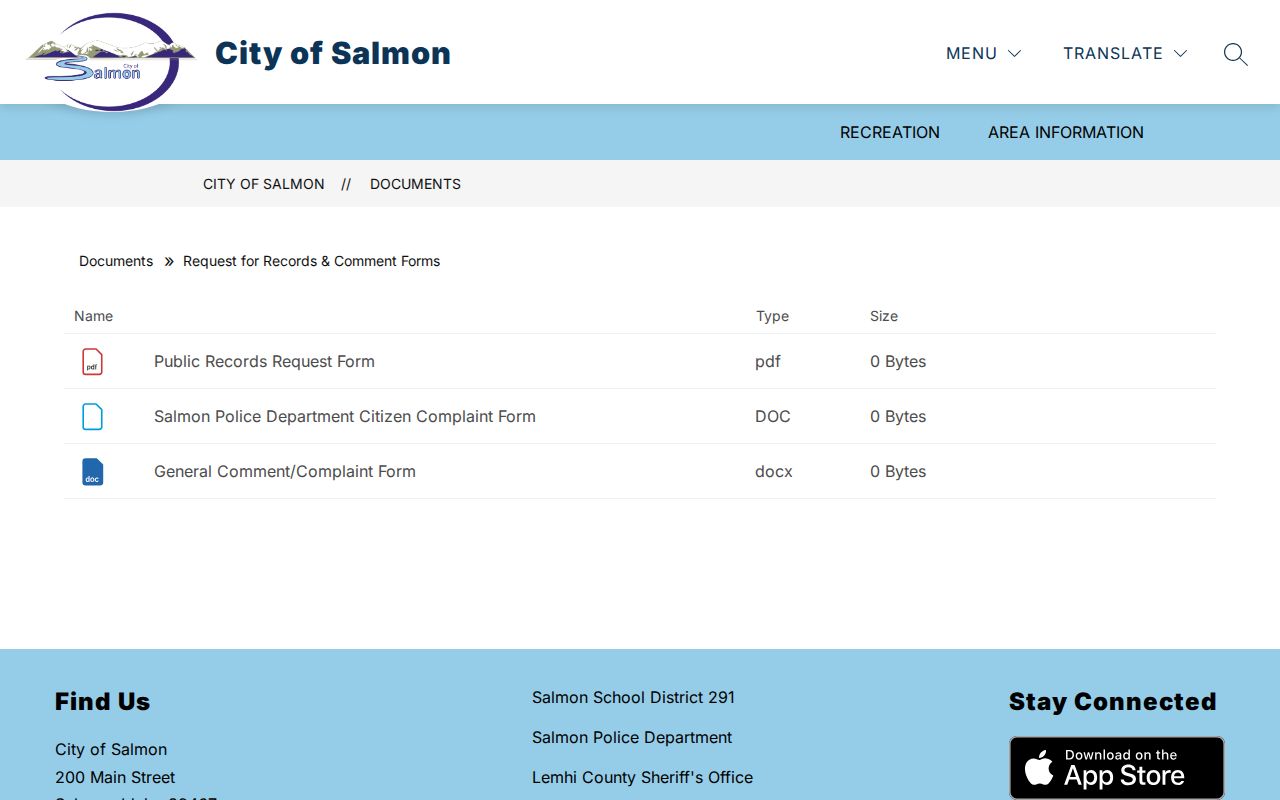
The preview makes clear that the requester must describe the desired record and choose examination or copies, while city staff document the response.
Salmon Police Report Requests
Salmon uses a city public-record form instead of an instant report download. The city clerk routes police and accident-copy requests. Describe the police department, the report type, the incident date or number, and the records sought. The form also asks for requester contact details and a signature tied to Idaho's ban on using public records to build prohibited mailing or telephone lists.
The choice between examining a file and receiving copies matters. The form lets a requester select either route and shows a copy cost of $0.10 per page. Staff fields document receipt, approval or partial approval, any added response time, and the reason for a denial. A narrowly framed request is easier to route than a demand for every record about a broad subject.
| Form choice | What to provide | What happens next |
|---|---|---|
| Examine records | Specific report, date, department, and contact details | City arranges access to releasable material |
| Receive copies | Same description plus preferred response channel | City states approval, copy cost, or needed time |
| Partial or denied access | No extra field required | Response identifies withheld material and appeal notice |
Records at Salmon Police
Salmon is the only incorporated city in Lemhi County with an agency listed in the Idaho State Police law-enforcement directory. Its headquarters is at 211 Poleline Avenue. The department lists a chief, lieutenant, sergeant, six patrol officers, and three K-9s. The chief's office number is 208-756-1347, while nonemergency dispatch is 208-756-8980. Officers are often in the field, and weekday messages are checked each morning.
Ask for the exact Salmon police product. An incident narrative, arrest report, crash report, CAD event, 911 audio, photograph, and body-camera video are not the same file. Give a date and time range, location, report or case number if known, involved names, and the preferred electronic format. Active investigations and material about juveniles, victims, medical facts, or protected identifiers may be withheld or redacted.
The official Salmon city site shows the local government context for the records channel.
The city page helps distinguish city-held police material from records kept by Lemhi County offices.
Salmon Dispatch and Police Records
Salmon's record path is unusual because the city and county share core public-safety functions. The police department directs people who need to make a report to Lemhi County Sheriff Dispatch and Jail in the courthouse basement. That does not transfer ownership of every Salmon police report to the sheriff. Salmon Police remains the creator of its incident and arrest narrative, while county personnel hold dispatch and jail products they created.
For a cross-agency event, ask each creator for its own record. City police may hold the officer narrative. County dispatch may hold call data or audio. Booking staff may hold intake fields, bond, and release data. This split is also why a single city request may not produce a full chain from first call through final disposition.
The official Salmon Police page documents the department and its shared dispatch route.
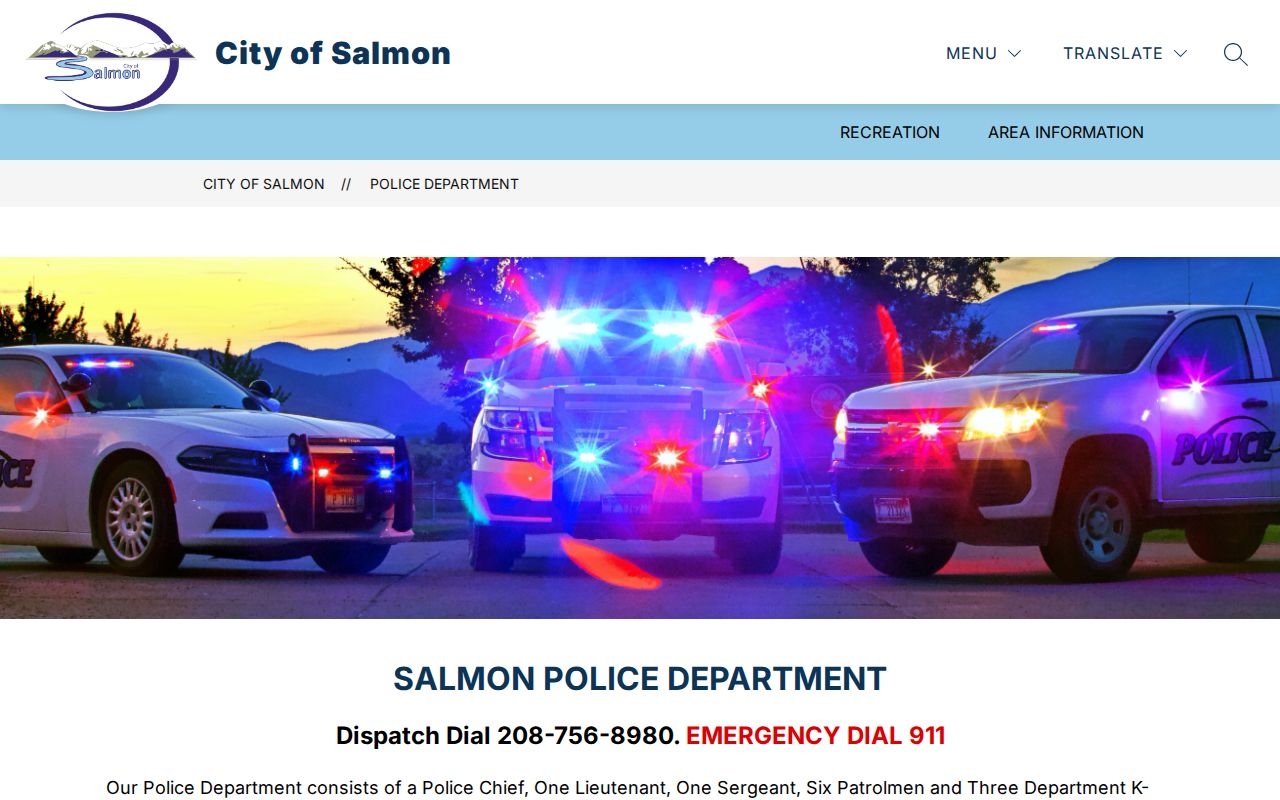
The department page points readers toward the right city and county contacts instead of suggesting one combined database.
Note: Call 911 only for an emergency; use 208-756-8980 for nonemergency dispatch and current-custody questions.
Booking and Arrest Records in Salmon
A Salmon arrest usually creates at least two local products. Salmon Police writes the investigation or arrest report. The Lemhi County Jail creates intake, custody, bond, and release fields after transport. The county describes a 26-bed facility that holds adult and juvenile detainees of both sexes and supports Salmon Police jail needs. It does not publish a live online roster, so current custody requires a call to dispatch or the jail.
Booking fields can include the booking number, arrest date and time, arresting agency, alleged intake charge, bond, court, housing, and release date. Some fields may be withheld. A court docket is the next check because an intake charge can change when the prosecutor reviews the report. The more detailed Lemhi County arrest search covers county request and custody channels.
Do not treat an arrest as a conviction. A person may be released without a filed charge, the prosecutor may file a different charge, or a court may dismiss or acquit. The charge-level disposition is the key fact.
Reading Salmon Arrest Data
Official ISP Crime in Idaho data gives useful context, but it is an agency report rather than a list of all events or a measure of personal risk. For 2024, Salmon Police used an agency population denominator of 3,357 and reported 47 Group A offenses, with 28 cleared. The agency recorded 48 adult arrests, compared with 38 arrests in 2023, while the count of reported Group A offenses remained 47 in both years.
Selected 2024 entries included 20 drug or narcotic violations, 11 drug-equipment violations, five simple assaults, five thefts, four aggravated assaults, and 27 Group B DUI arrests. These counts help explain what may appear in Salmon police and court records. They do not show that each arrest became a conviction, and they should not be used to label a person or neighborhood. Small local totals can also make year-to-year percentages look large.
The Salmon Municipal Court File
Salmon has no separate municipal court repository. Idaho's unified court system sends local citations, misdemeanors, warrants, initial appearances, and felony preliminary matters to the Lemhi County Magistrate Division. Felony trials proceed in District Court after bind-over. Both sit at 206 Courthouse Drive in Salmon, and the court clerk can be reached at 208-742-1673.
Search Idaho iCourt for public case status. Use the courthouse kiosk or clerk when a docket image, older material, or certified copy is needed. A portal result may omit sealed cases and protected events.
| Court Name | Lemhi County Magistrate Division and District Court |
|---|---|
| Case Types Heard | Misdemeanors, warrants, initial appearances, bail, felony preliminaries, and District Court felony proceedings |
| Case Lookup Channel | iCourt for status; courthouse kiosk or clerk for public documents |
| What the Docket Shows | Case number, parties, charges, bond, events, disposition, and financial entries when public |
| Copies & Fees | Contact the clerk to confirm search, copy, and certification charges |
Salmon Citation Search Choices
Use the exact case number when possible. A name search can return more than one person, so compare the court location, year of birth, charge, and event dates. iCourt offers Smart Search and Search Hearings. The public screen is a case-status index, not a promise that every filed document can be opened online.
A citation may first show a scheduled appearance and later display a plea, motion, judgment, or sentence. “Closed” is an administrative status, not a synonym for conviction. Read the disposition for each charge. If the public screen lacks the document needed, ask the Lemhi clerk to review the court file rather than sending a police-record request to Salmon City Hall.
How Salmon Records Reach the County
Each custodian adds a different part of the Salmon criminal record. Police document the reported event and grounds for an arrest. County jail staff record custody. The prosecutor decides which charges, if any, to file. The clerk records hearings and outcomes. Courts and prosecutors then report qualifying dispositions to Idaho State Police BCI.
Record flow: Salmon Police › Lemhi County Jail and Courts › Idaho State Police Bureau of Criminal Identification
A recent Salmon event may appear in police or jail records before it reaches iCourt or BCI. An older BCI arrest cycle may lack a disposition if the contributing data was not complete. Compare records by date, agency, case number, and charge rather than relying on a name alone. A fingerprint-based BCI self-review gives stronger identity matching than a name search, but it is not a copy of the local court file.
Salmon Records in Local Context
Salmon is the county seat in the Lemhi Valley and the service hub for a broad mountain region. Its civic identity is tied to the Salmon River and the Agai'dika Shoshone-Bannock homeland. The city-owned Sacajawea Interpretive, Cultural and Educational Center sits in a 71-acre park east of downtown, with a visitor center, research library, theater, amphitheater, and heritage gardens.
That setting helps explain the shared city and county record system. Police remain a city agency, yet dispatch, jail, courthouse, and many administrative functions are concentrated in Salmon. Historical research may begin with city or cultural collections, but a modern criminal case still follows the agency-to-jail-to-court chain. Keeping those aims distinct prevents a civic-history search from being confused with a current records request.
Salmon Record Access Rules
Police and city administrative records follow the Idaho Public Records Act. Court files follow Idaho Court Administrative Rule 32, while BCI reports follow the state's criminal-history dissemination law. These separate rules explain why a document open at one office may be redacted, sealed, or unavailable through another. Salmon may take up to ten days after notice when more time is needed under the resident request timeline.
Ask for a specific record, accept lawful redactions, and use the denial or appeal information on the response if access is refused. Do not try to bypass a seal or juvenile restriction through another custodian.
Key Statutes:
Idaho Code §74-102 presumes agency records open, requires a specific request, and permits certain actual costs.
Idaho Code §74-103 sets the resident response period at three working days or up to ten after notice.
Idaho Court Administrative Rule 32 defines public and exempt judicial records.
Idaho Code §67-3008 governs release and reuse of BCI criminal-history information.